Monday, May 14, 2001

Banners Versus Commercials

It's 2006 2012 as I write this update, and not a trade show passes that someone doesn't argue declare the a banner dead. As it happens,  I first heard this argument five eleven years ago in 2001, in an article published by The Silicon Alley Reporter.  A given banner, it was said, was ineffective unless one could determine that a potential consumer actively engaged with it -that is that they clicked on it. This argument sounds reasonable on the surface, but it also negates corresponding behavior exhibited by the consumption of off line advertising, and which could not yet be disavowed as anachronistic by modern communication devices. So, I wrote a response arguing that clicks don't matter as much as impressions, and happy to say, it was published.  More than a decade later the article is quite dated, of course, but I still think it provides a valid reminder that we should not  underestimate the power of a static image to influence, or overlook the possibility of deferred action (especially after repeated imprints). After all, asking potential consumers to click here there or anywhere is a bit like asking drivers to stop, get out of their car and kick a billboard before we can measure the value of the billboard. Granted, mere visibility and hoping doesn't provide immediate metrics, but those numbers can be measured by eventual sales.  I still believe in the power of 2D. But then, I also like the Beatles in mono. What say you?

–Terry O'Gara/ 2006 2012


Banner Vs. Traditional Television Advertising
By Terry O'Gara
Originally Published in The Silicon Alley Reporter, May 14, 2001

Banner ads are generally considered a failure. But how many click-throughs does a TV commercial get? A billboard? None. And it's probably better to compare banner ads to billboards than to TV commercials, which at least may entertain an audience, as well as suggest a call to action or purchase from consumers.

Great TV commercials and billboards can be extremely effective. The One Show Interactive Awards demonstrate that great banner ads can also be effective. The key word is "great"--as in great creative. The real lesson: Not everyone with a PC can be a new-media company. How many times does one learn the programmer was also the art director, the copywriter, the brand manager, and sometimes the composer or sound designer? All the time! The result is almost a promise of mediocre results.

Probably the only TV commercials whose effectiveness can be measured immediately, like banner ads, are those that close with an 800 number for ordering--the "click through" just requires pushing 10 buttons instead of one.

What may ultimately be important regarding the influence advertising has on consumers is not the medium, but the frequency, consistency, and mindfulness of the message.

It's difficult to measure the influence on my purchasing dollar by any kind of advertising. So, perhaps it's not whether banner ads work, but if any ads work? The answer seems to be bad ads don't work. Ill-conceived branding doesn't work. But a great billboard that I unintentionally look at may spark my interest, and the online equivalent--banner ads--may be as effective.

The banner medium can be more effective than a pop-up interstitial because it remains on the page your scanning. But the moment a pop-up opens, the window can be closed, often before it really gets going. I do that every time. So, in that case, maybe banners are more effective than television. Click.

Friday, April 27, 2001

RIP Vicki Sue Robinson


God bless Vicki Sue Robinson, who died on this day, April 27, 2000.

The world knew Vicki as the singer who demanded that the DJ turn the beat around. I was one of those fortunate to to know her. We became acquainted with each other while working on a variety of studio projects through the nineties. She lifted my spirits; made me laugh; made me sing and made me dance.

And her memory will always make me smile.

Thank you Vicki!

Monday, April 02, 2001

Blister Media: Interactive Composition Comes of Age

In Mix Magazine's Internet Audio supplement (April 2001), editor Sarah Jones asks the question, "Who is the new web audio professional?" She then goes on to take a stab at the answer and writes:

"Creating audio for the Internet requires a unique blend of skills, combining audio savvy, design creativity and programming knowledge. Audio professionals are learning about HTML and Flash. Web designers and computer professionals are learning about compression and sampling rates. Today's production team, like this month's featured creative talent at Blister Media, might be writing both a MIDI sequence and HTML code as part of a client project. Is this jack of all trades the new breed of creative professional?"

The feature story that followed that introduction was in depth interview of my partner and I about the practices we employed, sometimes invented, often combined and then championed as a new breed of sonic artisan that would be both music designer and creative technologist.

Here's the article:

BLISTER MEDIA
Interactive Composition Comes of Age
By Andrea Rotondo Hospidor

Terry O’Gara and Michael Sweet, owners of Manhattan-based Blister Media, are true musicians and creative collaborators. They speak the language of MIDI, sequencing and recording, but they also speak Java, Flash Shockwave, Beatnik, MP3 and RealAudio. The upshot is, Blister Media may just portend the future for all music production professionals.

The company is currently blazing trails as one of the few music houses that composes music–and creates code–for interactive media, and we're not just talking TV commercials, CD-ROMS and on-site installations; we're talking about composing music for the Internet. Recent projects include several sync-to-broadcast gigs, such as History Channel's History IQ game and MTV's WebRIOT. (Sync-to-broadcast synchronizes online content with on-air broadcasts, turning a TV show into an interactive experience.) Blister Media is also responsible for the new sonic identity of HBO Zone, music for Shockwave's BLiX and Loop games, music and sound design for the NASDAQ site in Times Square and a connection tone for a telephone company.

So, if you're a composer who presumes Beatnik has something to do with a Jack Kerouac novel, you'd do well to take note. The future of music composition ain't what it used to be.

MUSIC

Music, Noise, Code. That's the Blister tagline. According to O'Gara, "That translates to: original music, sound design and audio-specific programming as applicable for interactive media–including enhanced or interactive TV, special venues and electronic games–TV and radio commercials, broadcast promotions, phone connection tones, etc." To paraphrase David Byrne, how did they get here?

Both men grew up with a musical instrument in one hand and a computer keyboard in the other. "I grew up in a relatively artistic family," Recalls O'Gara. "I studied violin, worked as an assistant to the organist at a local church and played in a youth orchestra. I also had the benefit of growing in a family that traveled the world. So as a child I listened to the indigenous music of the Middle East, South America, the West Indies and Europe." But perhaps most significant in O'Gara's early music education was the day his parents bought him a Minimoog. He was 13 and just beginning to dream about the ins and outs of sound synthesis.

Meanwhile, in a sleepy Wisconsin town, Sweet was also growing up with music. It was the early '80's and he was learning to merge the computer world with sound. He went on to study music production and film scoring at Berklee College of Music in Boston.

NOISE

Later, both landed jobs at a well-known music production company in New York City: O’Gara following the production route and Sweet concentrating on composition. "We became creative collaborators from the start," notes O’Gara. "In the beginning, our collaborations were more experimental, explorative and noncommercial. We were mixing orchestral harmonies with world rhythms and hip hop loops. This was 1991. It was until 1996 that the world caught up with us, and our explorations became something people would pay us to create." Soon after, the duo created Blister Media.

"From the very beginning, clients would come to us for new ideas and we'd sell them on the idea of a symphonic piece of music being driven by electronically produced tribal rhythms, for example." O'Gara says.

CODE

As they honed their composition chops on commercials, interactive kiosks, installations and CD-ROMs, O'Gara and Sweet also dove into Flash, Java and Beatnik. It was this intimate knowledge of technology that landed them favor with Shockwave. They have since produced music for two online games: BLiX and Loop. In effect, Blister's tech-speak has allowed them to cross over into a world where programmers and musicians routinely collaborate music for the Web being an extension of that philosophy.

"Creating music for the Web takes sound to places where it can be heard on a very personal level," says Sweet. "When we create music for an interactive experience, the one-to-one relationship to the end-user is much closer than creating something that appeals to a broad audience, such as commercials. IN addition, the collaboration between all of the digital artists is much stronger, because it usually takes several months to finish a project."

NOSTRADAMUS FOR A DAY

O'Gara and Sweet advise composers and engineers to delve into audio for the Web–and interactive media–as soon as possible. Composers and engineers must know compression and delivery formats, and it's not enough to just hand your music off to a programmer. Smart production pros will play the active role in creating code.

O'Gara goes so far to say, "If a composer doesn't understand the technical issues regarding the way audio is delivered, then maybe he's in the wrong business. We'll see more and more of these technologies converge or act in tandem. Sync-to-broadcast is just one example. Our perception of what a composer, engineer or producer is has to change along with the technology. But we must emphasize that it's not just the tools. It's first and foremost what's in your head."

Sweet concurs, "When I first started exploring Beatnik, I had to get in that box and say, "This is what it can do. How can I push the box outward and make it do things that people haven't thought of doing before?" You start thinking, "Oh, I had this idea a long time ago and now here's a way to do it!"

TECHNOLOGY AND ART IN ACTION

How do O'Gara and Sweet really combine technology and composition? It seems to be two parts creative musical intelligence and one part kicking studio setup. The creative team runs off of both the Macintosh and PC platforms and mixes on a Mackie D8B digital console. Sequencing is done via MOTU Digital Performer, Digidesign's Pro Tools and Emagic Logic. Their synth rack is extensive and boasts an E-mu Proteus 2000; Roland JV-2080, MC-303, Juno 106, Super JX; Oberheim Matrix-6R; Minimoog; Waldorf WaveXT; and a Synclavier. They also own a host of software synths, Steinberg Rebirth and Recycle to name two. The E-mu E6400 Ultra and Digidesign's SampleCell handle the sampling chores; Macromedia Director, Flash and Dreamweaver round out their digs.

"It's not just equipment but an extension of our ideas," O'Gara says. "We love an eclectic mix of equipment. The tools, to some extent, define the process and the production method. The idea is that if our studio setup is atypical, then what we create will be atypical in nature as well."

Blister Media recently put their studio sensibilities to the test while creating music for a new Shockwave game called Loop. "Although, on first look, it's a relatively simple game," says Sweet, "it has many different levels, both visually and musically. One of the things that has always excited me about music for games is the ability t create a piece that changes every time you play it. In Loop, we structured the sound around playlists that could change in real time, as well as from play to play, giving the end-user a much richer musical experience."

Another recent project was Passport Kids for Children's Television Workshop. "The theme," Sweet says, "was communication. The site is translated into 10-plus languages, and people from around the world exchange information about themselves. When we were asked to add music to the site, we wanted to let users express themselves though music, so we built a musical sequencer and 'jam machine' that allowed users to create their own 'song' and play to other users. We used Beatnik as our audio engine, because it was a fairly robust music system that allowed us to bring custom world instrument samples and manipulate them in real time. When then wrote a lot of custom code to push Beatnik to its limits. The outer visual shell was then built using Flash that communicated directly with our code for Beatnik.

"When we first start a project, we look at many things," Sweet continues, "including the overall creative feel, interaction design, bandwidth/size and what new things we can do that we've never done before. Experimentation is a very important aspect of what we do, because we don't think the sound is made perfect the first time around. We always ask ourselves, 'How can we make it better? How can we push the boundaries of our current technology limitations?"

Sunday, April 01, 2001

The Post-Post Production Era

Blister Media sourced for THE POST-POST PRODUCTION ERA, a special report published in the April 2001 Advertising Age CREATIVITY magazine.

Writer/Reporter Ann-Christine Diaz writes:

Advancing technologies – the Internet, the imminence of interactive TV going mainstream, the explosion of new formats – are driving the redefinition of the post industry from being the last stop in the production chain to being an integral part of the entire creative process…

…Advancing technologies have opened up new sectors of specialization as well. Consider music and sound design. In 1998, for example, Terry O’Gara and Michael Sweet launched Blister Media in New York to cater to the sonic needs of the interactive community. Blister provided both the technology and sound for interactive projects like MTV’s Web Riot, a broadcast cable and Internet quiz show; the interactive game Loop on Shockwave.com; various web sites for Sesame Workshop; and the Nasdaq learning kiosks in Times Square. Such assignments go well beyond the needs of the traditional TV spot.

“We have more homework to do than someone who just has to kick out a track,” says O’Gara. “With interactive projects, everything relies on constantly evolving technology to deliver the message. Even though we’re a music production facility, we have to understand all the technologies our client is speaking – or at the very least, how our technology and code will integrate with theirs from project to project.”

Blister is not alone in its efforts; full service music and sound design houses like Elias Associates and Hest & Kramer in Minneapolis have both added what the Blister crew calls “interactive sonification” to their services.

Friday, March 30, 2001

Branding With Audio

Branding With Audio
By Terry O'Gara
First published on March 30, 2001 by clickz.com

Advertisers too often limit branding potential to visuals alone. It's as though once a vision statement is drafted in the corporate boardroom, it frequently goes out the door voiceless.

Certainly television commercials give products some sort of voice with original scores or licensed tracks. But many of these scores do not serve the company or product identity. Instead they serve to enhance the commercial itself. Licensed tracks pose another problem. The commercials are transformed in the minds of viewers to music videos, and whether viewers identify the music with the product takes a back seat to the artist and to the video itself.

Traditional Scoring Serves the Film, Not the Brand


Most conversations between agency creatives and the music-production team are usually limited to a few adjectives that describe the target demographic. There may also be some talk about how the music should work with the edit or how the score will enhance the emotional relationship between the actors or clarify the story. But these are all issues that apply to the commercial as entertainment. There is usually little strategic thought invested in how to actually create with sound a bond between the consumer and the product.

Though it's easy to think marketers and their vendors have formed a creative alliance to sell products, this is not always the case in today's economy. Rather we're acting as matchmakers for producers and consumers. We're using advertising then not to sell but to network. We're introducing one good friend to another, and one of them happens to make something that, by the way, appeals to the lifestyle the other leads or aspires to.

Sometimes we can't even offer usefulness. We might try to promise uniqueness, but there may be few discernible differences between your product and your competitors'. One soda conveys universality while the other appeals to individuality. But oats are oats, and cola is cola. So if you're not accentuating the brand, then you're left pushing flavored water. However, as marketers, we know a little stimulation goes a long way.

Branding Through Sound

My specialty is sound. And I submit that unless you are using sound as effectively as possible, you're shortchanging your client. So the question arises: How does one go about creating a voice every bit as identifiable with the company as the building in which it dwells?

First let's change our perspective. I suggest we move away from thinking of commercials strictly as anecdotal short films with strategically placed product shots. Story telling by itself is only one device at our disposal to garner the interest and attention of our desired audience.

But branding beyond advertising means we want to do more than simply tell a story. What we really want to do is make an introduction and deliver a message. Branding is the vision statement given life, and it represents an opportunity to ingrain one's identity into the public consciousness. One highly effective way to do just this is with the prudent and thoughtful use of sound.

Creating a Philosophy of Sound


Some years ago I was the music producer on a campaign for a large investment bank. One of the VIPs came to our initial music presentation when everything was still in an embryonic stage. He was a layman. I sensed the more musically astute people in the room resented his presence. But I found that because he knew his brand thoroughly, he also understood how it should be conveyed sonically.

He didn't play a musical instrument, nor did he know any of the proper musical terms. But he knew how music made him feel and that different instruments evoked different moods. Most important, he could articulate his perceptions quite clearly. To me he represented the ideal client.

It's valuable to know not just how an audience will react but also, more precisely, how they can be made to react. Our VIP didn't know if he was listening to violins or contrabasses, but he knew the high strings evoked one mood, and the low strings another. The sound of the low strings conveyed "a sense of authority and power," and that's what he wanted.

So despite all the preproduction meetings in which the agency creative staff, the director, and the editor all discussed how the music should work with the cut or enhance the story, one brief conversation with someone who knew nothing about music proved to be the most valuable. And we, in turn, were then able to create an audio style guide that would influence the sound campaign for this account for years to come.

Although the same film-scoring issues surfaced with future spots for the same client (i.e., the story, the edit, etc.), we now had a philosophy of sound, the corporate vision statement as it applied to audio. Every new piece of music, no matter what the melody, was designed using the same palette of sounds and was thus easily identifiable as this client's sonic identity. One needn't even see the visuals to appreciate that your "Friends at the Bank" brought you this piece of music.

The Power of Sound in Branding

I put forward that every sound asset used in a commercial, on an in-store kiosk, or on a Web site should be easily identifiable as the voice of your company. Do you know what your company is saying right now?

If music in a marketing context does its job, it will inform as well as entertain. And if consumers -- that is, your audience -- call the company switchboard and ask who wrote the music and where they can buy a CD of it, then maybe you and your client should actually produce a promotional CD that consumers can take home and listen to whenever they want.

Branding beyond advertising means creating an experience that is free of an overt pitch yet is compelling enough that consumers will nevertheless identify it with your brand. If you've produced a CD, for instance, folks will listen to it while they eat, work out, make love, and your company will be the underscore to their lives. Oats may be oats, but if I'm making babies to your music, then chances are my babies will be eating your oats.

Wednesday, February 28, 2001

Blister Media Brings Sound to the Nasdaq Experience


In 2000, Blister Media was commissioned to produce branded audio elements for the NASDAQ MarketSite, located in the heart of Times Square. The following press release was issued by the producers of the project, and I reprint it here because it details our music production process. It may also mark the first time we started referring to the work as 'Sonic Branding' –the now popular coinage for the term. My partner and I had considered using the term as early as '98, but instead opted to use the word 'Audio' because it felt more in tune with the late nineties zeitgeist (ala Audioslave), and so prior to 2001 we referred to our services as 'Audio branding' or 'Branding with Audio'.


BLISTER MEDIA BRINGS SOUND TO THE NASDAQ EXPERIENCE
PRESS RELEASE
FEBRUARY 28, 2001


Apart from being the stock market for the digital world, The Nasdaq Stock Market® now has a place in its MarketSiteSM where visitors can learn even more about the 21st century world of stock trading. The new visitors’ center is a new, integral part the Nasdaq MarketSite, which is located in the Conde Naste building in New York City’s fabled Times Square, and it has become a tourist attraction in its own right. It also represents a year-long effort by the audio designers at Blister Media.

“No matter how inexperienced at investing visitors may be, I hope that they leave here with the enthusiasm to go home and trade stocks on Nasdaq®,” explains Blister Media executive producer Terry O’Gara. “Our goal was to make electronic trading with Nasdaq an audio adventure, and to brand the visitors’ center with a sonic palette that reinforces one’s experience. We didn’t want people to scratch their heads and say ‘interesting.’ We want them eager to trade stock and take part in this economic adventure.”

Nasdaq commissioned Blister Media to create audio content for the “Nasdaq experience,” at its MarketSite, including original music and sound design for the on-site destinations. On the street outside, a forty-five second “Welcome Video” entices passersby to enter and once inside, a five-minute film entitled, “The Global Connection,” plays in a surround-sound theater. The film explains the essence of Nasdaq and the online trading experience. Just past the theater, a bank of interactive kiosks let visitors play a game that simulates online trading.

“The trading game is just for fun ,” says O’Gara. “The data used, though, is culled from the last five years of Nasdaq trading history, so a player can see how well he or she might have done if introduced to the Nasdaq experience earlier.”

Drawing closer to the actual experience of electronic trading, another set of interactive kiosks offer a detailed offline tutorial about navigating the Nasdaq Web site.

“The music is different for each event,” explains O’Gara. “Each is customized. Every sonic element was deliberately conceived to provide Nasdaq with a uniquely cohesive and identifiable sound. Nasdaq was an exceptionally cool client. Beyond our initial conversations about concept, they gave us absolutely free reign in seeking a musical direction. They showed a great deal of trust, which is always gratifying.”

Among the other challenges for Blister was creating a “sonic brand” for the Nasdaq experience that would stand the test of time.

“In this industry particularly, what sounds new today, sounds old tomorrow,” says O’Gara emphatically. “The music we created sounds modern, but isn’t based on musical fads or pop culture. The idea was to give the music ‘legs.’ Instead of relying on the latest electronic sounds, the scores we composed use traditional instruments in ways they weren’t originally intended to be used. Using the guitar, for instance, we would create an unconventional sound, and then manipulate it using computer technology. The result is an electronic sound that is nonetheless organic, a sound somewhere between music and noise.”

Another challenge involved appealing to the multitude of international visitors to Times Square. “In attracting international visitors, the temptation is to use traditional indigenous instruments,” explains O’Gara. “For India, you might think of the sitar, but we wanted something different. We wanted to use traditional instruments from around the world, but to play them in a non-traditional manner to get the feeling of the instruments, without the immediately identifiable trappings. We also recorded voiceovers in six different languages for the guided tour.”

* * *


NASDAQ MarketSite Credits:

NASDAQ TEAM:
Larissa Fawkner - Special Projects, MarketSite Experience
Karen Wilner - Director, MarketSite Experience
Miguel Iglesias - Manager, MarketSite Experience

DESIGN TEAM:
Eleanor Tsang - Senior Producer (Film/video/Guided Tour)
Alexis Menten - Producer (Film/video/Guided Tour)
Jaseung Coue - Producer (Film/video/Guided Tour)
Jason Carreiro - Producer (Film/video/Guided Tour)
Elizabeth Rankich - Interactive Producer (Market Watch game)
Dana Yee - Art Director/CD (Film/video/Guided Tour)
Pakorn Bupphavesa - Senior 3D Animator/Art Director/CD (Film/video/Guided Tour)
Haejin Cho - Senior Designer (Film/video/Guided Tour)
Gary Tam - 3D Animator/Compositor (Film/video/Guided Tour)
Adrian Kays - Editor (Video)
Darcy Bowman - Editor (Film)

AUDIO TEAM:
Composer – Michael Sweet (Film, Video, Game, Installation)
Executive Producer – Terry O'Gara (Film, Video, Game, Installation)

Thursday, February 08, 2001

Thoughts On Audio @ Point of Purchase

Have by now produced audio for several installations and in-store experiences, including Kiosks for Chrysler, Discovery Store, Epcot, Levi's and the Nasdaq MarketSite. And something like this has been bubbling around my head lately on the topic of interactive audio triggered at Point of Purchase locations and special venues:

The overt pitch has been abandoned in favor of something that resembles entertainment. The eyeballs surfing the web are not just eyeballs, but eyeballs with brains. The consumers are not just shoppers, but audience members. And unlike Television advertising, point-of-purchase venues don't have the luxury of seducing the viewer with a cinematic short story.

This new consumer/fan is not at home pondering the warm and fuzzy feeling of your brand. They are on site or in the mall staring at the display or monitor, hopeully engaging in the experience. And perhaps now, they are ready to make a choice. At this stage they want immediate and honest information. You have a few seconds –and certainly not more than a couple of minutes– to make an introduction and deliver a message that inspires them to make a purchase.

How will you fare?

One thing is certain: You will need more than a loop to create an emotional bond between brands and fans.

Monday, January 01, 2001

People to Watch –Me– Hooray

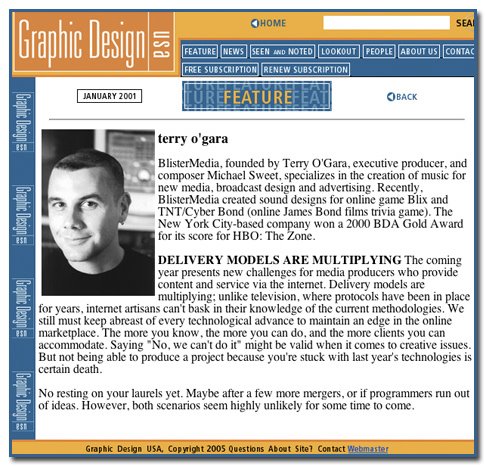
Graphic Design Magazine kicked off 2001 by featuring 50 'People to Watch'. The editors wrote, "Clearly there are thousands to watch in our talent-laden and personality-packed community. But we think you'll agree that these 50 are intriguing individuals who display a special mix of design talent, strategic capabilities, business acumen, joy of creation, and, often, a commitment to professional and public service."

I was really lucky to be selected among an incredible group of people whose reputations I can't begin to live up to. Naturally, of course, they required a nifty quote and I gave it to them–


DELIVERY MODELS ARE MULTIPLYING The coming year presents new challenges for media producers who provide content and service via the internet. Delivery models are multiplying; unlike television, where protocols have been in place for years, internet artisans can't bask in their knowledge of the current methodologies. We still must keep abreast of every technological advance to maintain an edge in the online marketplace. The more you know, the more you can do, and the more clients you can accommodate. Saying "No, we can't do it" might be valid when it comes to creative issues. But not being able to produce a project because you're stuck with last year's technologies is certain death.

No resting on your laurels yet. Maybe after a few more mergers, or if programmers run out of ideas. However, both scenarios seem highly unlikely for some time to come.


My esteemed colleagues –class of 2001– included the rockin' and talented: Joan Nicosia, J.J. Sedelmaier, Sharon Mahoney, Mike Hughes, Ken Hanson, Diane Sterman, Susan Vinik Consales, Ed Han, Chris Do and Jessie Huang, Natalie Pryor, Rondi Tschopp, Carla Hall, Robert Keren, Bill Thorburn, Rob Deluke, Brad Gensurowsky, Kent Hunter, Jackie Merri Meyer, Doug Joseph, Sam J. Ciulla, Tim Larsen, Janet Odgis, Kenneth Cooke, Brian Hill, Jaye Donaldson, Jonathan Pite, David Ford, Dave Miller, Dennis Ryan, Kenneth White, Iti, Candy Piemonte, Kenneth Quail, Victor Rodriquez, Bonnie Barnes, Bob Whitmor, Scott Sugiuchi and Steve Carsella, Limore Shur, Todd Mueller, Joe Lisaius, Robyn Streisand, David Annunziato, Brian Diecks and Gerri Guadagno.

Sunday, December 31, 2000

Assembling the Machine Head Dream Team

I spent nearly two jet set years operating as the Executive Producer and Creative Director of Machine Head, New York – and was charged with leading bicoastal operations for the legendary sound designer, Stephen Dewey.

I spent a week of nearly every month in LA, which I loved, enjoying creative work, tacos, daiquiris and KCRW with both Stephen and Patty Chow, both of whom I really liked. The trips out west also provided me some some surreal professional moments whereby I found myself taking meetings with The Dust Brothers and Anton Fier of The Golden Palominos; or producing the likes of Ralph Schuckett.–who co-produced Sophie B. Hawkins hit ‘Damn I wish I Was Your Lover’ with Rick Chertoff; and David Baerwald, an original member of the Tuesday Night Music Club. But here’s the deal with producing guys like that: They don’t need another expert in their lives; what they require is another expert ear to bounce ideas off of. If there's anything I know, it's how music should work with picture.

Machine Head hired me to extend the west coast presence to New York, but once he did so I wanted to kick down the doors, storm the Big Apple, and show him we could be also be kings.

Back in New York, I assembled a crack team of young composers, each possessing an amazing core competency in a different arena from the others, a formula that lent itself to collaboration; and none of them yet possessed a wide reputation in the industry.

[Initiate 'Mission Impossible' Theme in a new window before proceeding–]

Deniz Hughes
had worked as an arranger for the feature film composer, Elliot Goldenthal. Her own music was playful, passionate and always wonderfully emotive. The first project we worked on together went straight to the Super Bowl and proved to be the highlight of the year.

Michael Sweet, a graduate of Berklee’s film composition department, started his career as an engineer for Jonathan Elias before emerging as the company’s technology guru. He left Elias at roughly the same time I did, in 1996, in order to become a free agent and did business composing music for electronic games as ‘Building Hal’.

Valerie Wilson Morris and Chris Botti recommended Georg Brandl Egloff to me, some years before, when I mentioned that I was looking for a lyricist. I’ve long forgotten what happened to the lyric project, but Georg’s music was super-contagious. Few swing like Egloff: Stick him in a room with a jazz trio and wait for the roof to blow off. I still owe Clinton Recording Studios damages to the ceiling in studio A.

My go-to rock guys were Eric Schermerhorn and Hal Cragin, whom I hired as a team on several spots. Representing two thirds of Iggy Pop’s former rhythm section, there was nothing the three of us couldn’t work out, lugging equipment, tape, guitars and chord charts all over New York and from disparate home grown analog studios in the East Village and Chelsea.

I hired other people along the way, too, for specific projects –notably Shari Feder, who always delivered world class goods, on time, on budget, and her work always sounded ready for broadcast. She came recommended by Mike Davis, who is perhaps most know for playing bone with The Rolling Stones. What I didn’t know at the time was that Mike and Shari are husband and wife. Whatever, the nepotism worked out great, so keep it coming. You got any kids, Mike? Do they play an instrument yet? Cause I got a project that needs a kid…

Rounding out the East Coast contingent was Bill Chesley, an artisan and a meticulous sound designer who was the only one of the bunch who had already carved out a reputation and had a fan base.

We made a big initial impression on several major advertising agencies, and thereafter it seemed like The Gods on Madison Avenue constantly fed us projects. For the first time in my career it seemed like I consistently had my finger exactly placed on the pulse of popular taste.

I usually pitched musical ideas by myself based on an initial review of sketches or storyboards. If I could get our clients invested in an idea, then I knew we’d have an easier time of it, if only because then everyone would be on the same page.

Then, during development I’d work with each individual composer on their presentation –as a record producer works with an artist– until I was no less than greatly enthusiastic about his or her work. Sell it to me and I'll sell it to America. Some clients thought I was being disingenuous when they asked me, which was my favorite demo, and I’d reply that I liked ‘All of them’.

But it was true: I never let myself walk into a meeting without a pocket full of hit tracks. I really believed that if I loved the work I was presenting, all of America would have to love it, too. Fortunately for me, this belief was confirmed by our frequent success.

Yes, I suffered a few miserable failures, too. One client asked for a ‘modern’, ‘edgy’ track making it perfectly clear that the agency would not accept an orchestral score. In my gut I knew the boards demanded a symphonic tonality. Nevertheless I gave him what he thought he wanted. He took the job to another house who of course delivered the orchestral track that I knew we should have given him in the first place. I still beat myself up over that one, but you live and learn: Give them what they want, but also give them what they need, and while you’re at it –and if you have the time– why not have some fun and give them what you want, too.

For a brief while in 1997 though 1998 my hand picked crew shone with the brightest of the bright, and they made me proud to be a member of their team.

It was –I think you can tell– a lot of fun while it lasted.


[Fade Music]


(Hey, was that possibly the first musical cue for a blog?)

Saturday, December 30, 2000

Executive Producer Machine Head/NY 1996-1998

In December of 1996 Stephen Dewey, the acclaimed Los Angeles Sound Designer –whose company Machine Head, had practically defined the standard of sound design– called me up at home at exactly the same time I was trying out a new fangled thing called the Internet.

Stephen started his career as sound engineer and electronic devices guru for The Thompson Twins; went on to be a Product Specialist for the Fairlight Computer Music Instrument company; did a stint at Hans Zimmer’s film scoring company, Media Ventures; and then riding on the recognition earned by producing effects work for Ridley Scott’s film Black Rain, founded Machine Head, naming it after a mechanical guitar part.

Over the years, Dewey’s company and the team at Elias Associates had provided elements for some of the same projects. I had spoken with him several times over the phone –in order to coordinate elements– but I had never met him person. In fact, as the Senior Producer at Elias, I considered him a main competitor. Our team also produced sound design treatments; and Alton Delano –in particular– did such an excellent job of it, that it frustrated me when clients split their projects up between our two shops; but sometimes they did.

I would of course later come to understand exactly how and why Dewey outshone the rest of the Industry. Sound Design wasn’t just an area of expertise. To members of the advertising community, he defined the standard by which all others would be judged.

By Sound Design, I mean both the actual creation and construction of any given sound, and it’s creative application to film and video. Later –after I began working for him– my contribution to the company’s marketing strategy was to convince our clients that what Machine Head produced was less an effects treatment –which any editor with a sample library could provide– and more like an electronic music composition, which indeed was the truth. Many of Stephen’s efforts are comparable to and reminiscent of the groundbreaking work of Pierre Schaeffer, which Schaeffer so famously called ' Musique Concrete'. In the case of Stephen's work, think John Cage with Hollywood attitude.

Now here he was, former competitor and industry legend –not to mention ex-guitar tech for The Thompson Twins– and he was inviting me to come work for him. And oh, by the way, the first project on my To-Do list would be to produce a spot for the upcoming Super Bowl (MCI ‘Kids In Space’:60/:30), which would require me to hop back forth between both coasts between Christmas and the broadcast.

Essentially, my signing bonus was getting to produce a three million dollar video that everybody on the entire planet was going to see, hear, and talk about.

Graciously, I accepted, and then ran out into the New York night to celebrate the beginning of a new sonic adventure.