I'm intrigued by the idea of Silent Raves. In some instances, everyone listens to the same music broadcast to wireless headphones. But at other seemingly similar parties, each participant instead shows up with their own iPods and personal playlists in tow.
This former rave is both a party and a public service (for the neighbors), but the latter speaks volumes to the power of individually selected music: The members of this tribe may share the same dance space, but they certainly aren't dancing together, at least not to the same unified beat.
I wonder if raves of this sort can reach the same ecstatic highs as the former often do, if its participants aren't experiencing the same musically induced emotional ride at precisely the same time, the way a deft DJ can coax simultaneous and shared joy from a crowd thousands.
Individuality and personal branding are important elements in today's modern media centric society, but we also miss something if the singular intention to bask in the reverberations of our own message makes communication with others impossible, or even irrelevant.
Thursday, February 01, 2007


Tuesday, January 23, 2007
Time and The New York Times
In Natalie Angier’s January 23rd article, Making Sense of Time, Earthbound and Otherwise (©2007 New York Times, Science), she writes:
"The long and short of the universe is just that, almost exclusively long and short, with the hyperclipped quantum clickings of the atom on one end and the chasmic lollygags and foot drags of the greater cosmos on the other."
Human rhythms she reminds us, are bound by the simple coincidence that we are born on a tilted planet, one which takes 24 hours to make one revolution around itself, and 365 revolutions to turn around the sun.
So, it appears the rhythm of life falls into place like a jazz fan tapping his foot to a cosmic pulse.
"Every cell of the human body pulses to a circadian beat, sucking in glucose, squirting out hormones, building up fresh proteins and breaking down stale ones, all in predictable swells and troughs throughout the day,” Angier continues, "–a rhythmicity that may help explain why we love music but still does not explain the lingering popularity of Bachman-Turner Overdrive."
I picture aliens on Mercury taking a week off from work every eighty-eight days, in order to celebrate the Winter Solstice with gifts, and sing in a New Year.
"The long and short of the universe is just that, almost exclusively long and short, with the hyperclipped quantum clickings of the atom on one end and the chasmic lollygags and foot drags of the greater cosmos on the other."
Human rhythms she reminds us, are bound by the simple coincidence that we are born on a tilted planet, one which takes 24 hours to make one revolution around itself, and 365 revolutions to turn around the sun.
So, it appears the rhythm of life falls into place like a jazz fan tapping his foot to a cosmic pulse.
"Every cell of the human body pulses to a circadian beat, sucking in glucose, squirting out hormones, building up fresh proteins and breaking down stale ones, all in predictable swells and troughs throughout the day,” Angier continues, "–a rhythmicity that may help explain why we love music but still does not explain the lingering popularity of Bachman-Turner Overdrive."
I picture aliens on Mercury taking a week off from work every eighty-eight days, in order to celebrate the Winter Solstice with gifts, and sing in a New Year.
Monday, January 22, 2007
Ancient Audio Free With Every Brain
 In Same Old Song, but With a Different Meaning (© Copyright The Washington Post Company, Monday, January 22, 2007; Page A08), Washington Post Staff Writer Shankar Vedantam discusses the impact music has on brain behavior. The question isn’t if music stimulates brain behavior, but rather how.
"For neuroscientists," Sherpe writes, "the power of music poses a puzzle." He then reports how McGill scientist Robert Zatorre found that music "activated very ancient parts of the brain."
Meanwhile, two decades prior, in 1984, in The Secret Power of Music, David Tame wrote:
"…science is beginning to suspect that matter is all composed of one fundamental something, and that the frequencies or rhythms of this something determine the specific nature of each object and atom."
Sound, it seems is everything; and it certainly is if we are to believe the quantum notion that every bit of composed reality is a vibrating element of a wide electromagnetic spectrum, which we are only capable of seeing and hearing but a nano-sized slice of.
It almost begs the question, is sound particles or waves? Of course, we know the answer is waves. However, we might also suggest and imagine (if only as a thought exercise) that any transmission that communicates meaning is actually composed of micro sized particles of symbolic data
Carl Jung hypothesized that humans are born, not just with their physical body parts, but that our brains inherently contain what he called the collective consciousness. The collective consciousness, he suggested, was composed of "the residues of ancestral life… (whose) origins can only be explained from assuming them to be deposits of the constantly repeated experiences of humanity."
So then why shouldn’t we who are aural centric also suppose then that some of these ancient deposits inlude archetypal sounds that endow us with the building blocks of music and the (metaphorically) sub atomic sonic particles that make all audible means of communication possible?
And might such sub atomic particles, the substance of archetypes, be made manifest as signs, and thus be subject to analysis and potential manipulation by capable semioticians, wielding a craft one might call 'Sonic Semiotics?
Independent of any prior use of the term, I arrive at this phrase simply because of what I perceived as limitations on the scope of analysis presented by traditional music semiology. That is to say, I arrive at this analysis as not just a composer or musicologist might, but from the position of someone involved with commercial audio production, one who often produces music as a means not simply to enhance dramatic action or otherwise entertain and promote a story experience, but as someone commissioned to use sound in order to fulfill a marketing objective (and deliver a message, if you will).
So, when I say 'Sonic Semiotics', I mean the analysis of any sound unit, not just musical sounds, in order to determine the inherent symbolic 'message' that a given sound might serve as a carrier for, and whether that message is culturally born while other transmissions affect us a certain way because of a bio musical code or archetype that is possibly part of our DNA.
For instance: Audible emissions such as a GIGGLE, the tonal properties identifiable with a cry for HELP (in any language), the spoken word 'MA' or 'MAMA'; and non human audio such as the rumble of thunder or the rustle of wind through long grass, even the revving engine of a Harley Davidson; or a wail –be it produced by a grief stricken mourner or the SIREN call of law enforcement– these things all absolutely possess inherent symbolic properties.
Although, I have also considered that perhaps the emission 'Ma' is simply the sound a baby makes as he pulls his lips away from his mother's bosom. And the proud mother thinks the kid has actually said something, and then repeats it often enough that it eventually becomes his name for her. Maybe? Anyway, moving along–
Certainly, the diversity of species is great, but is there any animal whose GROWL does not induce fear?
This is not to diminish the power of symbolic sounds that can be found in much music, but rather to suggest that my search for inherent semiotic properties of sound are found in much smaller units than musicologists generally identify. I think more of what is today called music semiology can more accurately be described as Sonic or 'Music Memetics', if we allow that a meme, in the broadest sense of the term, "is any thought or behavior that can be passed from one person to another by learning or imitation".
I think this definition lends itself to the consideration of motif sized musical expressions with greater exactitude than 'semiotics'. Whereas to my mind, semiotics more accurately describes expression via symbol, that which the motif serves as a memetic carrier for.
Monday, January 01, 2007
Happy 2007 Update – About Critical Noise
 Happy New Year!
 –Or if you've arrived to this post via a search query–
Welcome.
So, what's this blog all about?
CRITICAL NOISE is about SOUND in all its many facets–
–From natural phenomena to sonic branding and other musicological topics. And as it can be heard in the ecology, our educational institutions, entertainment, industry, advertising and everything in between.
This blog is not a personal dairy, nor do I even think of it as about me, so much as it's about my experience with sound. I do keep a professional journal but I don't use it to write about the sometimes esoteric topics presented here. Critical Noise is like the op ed section of a newspaper that only reports about sound.
I attempt to post one article a month, up to 3000 words per article (they do get long). I may post an article in its entirety initially, but then later break it up into a bite size installments before archiving, if only to test the patience of those who do stumble here from search engines.
And few people want to read a 3000 word think-piece on the relationship between early childhood development and bird song as much as I may want to publish it. But if you are one of those people, you've come to the right place (Aural Intelligence ).
None of the articles published here are time sensitive, although some links may naturally expire. If you love the subject of sound, you'll equally enjoy my most recent entry as you will something I posted several years ago.
Want to get started? You can start at the top and work your way backwards but I suggest you head over to the index and sort entries by tag or subject.
So, who am I to assume such an interest or fair degree of expertise in these topics?
My name is Terry O'Gara. (A select list of clients and accounts can also be found listed in the left margin).
Beginning in 1991 I've made a living producing commercial music, sound design and sonic branding projects. And since 2003 I've provided brand and image marketing solutions, in the capacity of a creative consultant, to independent artists, artist management and creative entrepreneurs doing business in the advertising and entertainment industries. Interested parties are welcome to contact me via email to the address listed in the left hand margin.
Along the way I've been fortunate enough to have had the opportunity to produce, direct audio or otherwise contribute to a fair number of projects that went on to be recognized by the Advertising Entertainment Complex and international design community. So, yes, I've got a few awards. Earning them was once important to me. I only mention them now by way of providing readers with credentials.
CAREER HIGHLIGHTS
* I was a key member of the first team of music supervisors supported by a commercial music house.
* I was a senior producer on the first Olympic music library delivered with Meta tags and a digital database.
* I was one of three internal supervisors/ producers that created that first Meta tagged music library –pre iTunes.
* I was the senior producer for the first commercial music company to offer product ‘sonification’; and in this capacity I produced –or was part of a team that produced– sonification assets for AT&T and TeleTV, an early interactive Television platform.
I was also the senior producer for the first company to produce corporate audio identity systems, where I became the key architect of standard operating procedures for production at what turned out to be the first U.S. bi-coastal music production house and the leading sonic branding enterprise of its time.
Additionally, I was an early adopter of pre Protools computer technology as a musical instrument and recording tool; and co-founded the first dedicated interactive music production house that catered to Silicon Alley. Blister Media was the first music company to provide music, sound design and code as a standard service. Mix Magazine, in their Interactive Audio supplement suggested Blister Media's hybrid practices were a portent to ‘The Future of Music Production’. And as such, Blister Media was the first music house to provide such services for Sync-To-Broadcast events/experiences, such as for MTV's webRIOT.
I've also produced sonic identity and music imaging promo packages for ABC, CBS, Disney, E!, ESPN, Fox, HBO, MTV, TBS, TNT, TNT Asia, The Comedy Channel, PBS, VH1 and not to mention TV and Radio projects for many household brands.
The best part of it simply was –and is– the opportunity to work with other uniquely talented and creative people in the earnest attempt to create remarkable advertising, accessible information and maximized entertainment entertainment experiences.
And so much the better if we burn a blazing trail while doing it.
* * *
THE MUSIC PRODUCER'S SYLLABUS
Young people (or the simply curious) interested on just exactly what a commercial music producer is and does on daily basis are invited to read a number of articles I've composed explaining as much and collected under the the series title:
The Music Producer's Syllabus
Academic Institutions and persons are of course invited to print, distribute and expand on The Music Producer's Syllabus for limited educational purposes. Kindly credit and notify the author via email, and provide a trackback or originating URL.
* * *
I hope you enjoy reading Critical Noise.
Comments are invited.
Spread the knowledge.
Terry O'Gara
* * *
(This article last updated January, 2009)
Friday, December 01, 2006
When Marketers HEAR Double
In the November 28th issue of the Wall Street Journal, Emily Steel reports in an article titled 'When Marketers See Double', on unwitting overlap by advertisers who coincidently choose the same photo for parallel running campaigns. One notable example given is when Bank of America and Key Bank, the article points out, both chose the same ‘heart warming’ image of father and daughter hanging over a laptop.
Consider this example presented by the Wall Street Journal, and culled from the US BankCorp and Travelers respective Websites:
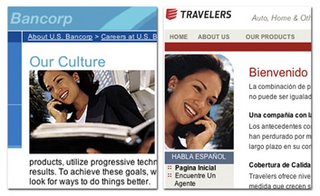
It occurred to me that this phenomenon is even more prevalent in the music and sound design we hear on TV and Radio commercials, and sometimes embedded into the soundtracks of the productions themselves.
One reason for this is the convenience afforded by MUSIC PRODUCTION LIBRARIES. Production libraries are collections of prerecorded music created specifically for use as audio companions to visual material, such as film and TV. Often cheaper than commissioning an original score, media producers also like production libraries because licensing is a snap. Like stock photo libraries, the contents in a music production library are rarely licensed for exclusive use, meaning someone else can come along and use the same track for their TV show, movie, commercial, et al.
Another source of recycle sound is the increased reliance by composers and sound designers on SAMPLES.
SAMPLES –as is commonly known– are short audio recordings, which are then often used as fodder for composers and sound designers. Sometimes samples are recorded from existing works: That's how The Meters and James Brown became embedded into countless Hip Hop tracks.
But most often samples are recordings of instruments (or ensembles) playing singular notes (or short rhythms) in every style, and then compiled into a 'library'. The samples are typically arranged across a keyboard making it easy for anyone to summon up a string orchestra with the push of a button.
Other common libraries include Loop libraries, which contain a measure or more of a rhythm track. Re-recorded and looped in a composer's computer, the loops become the basis of what one hopes is something otherwise original.
Or as ILIO –makers of the Vienna Strings Library– likes to say: "Virtual Instruments, Sample CDs and CD-ROMs, Loops, Sounds, Software and Tools for the Modern Musician."
Although, I think modern has nothing to do it with it: Samples –notwithstanding the fact that they can be quite effective– are just way cheaper than hiring a sixty piece orchestra for a demo.
As it stands, there are so many sample libraries today, that every instrument, in every configuration has been recorded. Need a Stradivari violin, cello, oboe, didgeridoo? No problem. Need rock guitars? –A techno loop? –A hip hop beat? Simply Add to Cart and proceed to Check Out with a valid Credit Card.
There are also libraries that cover the gamut of sound effects. Everything from car drive-bys (for every model manufactured) to 'ambient' or 'atmospheric' FX that call up specific genres, like, 'scary', for instance.
The result of this trend in using samples for every audio event in a music or sound design track is that we –the audience– are hearing the same sounds over and over again. For those of us with any kind of aural intelligence, an hour watching television can drive you batty as you hear –yet again– the same sound used in a ten year old X-Files episode recycled for the millionth time in a video game or a commercial, and now in the show itself.
It’s as though every soundtrack composer and sound designer on the planet is now drawing from the same pool of pre-recorded stock sounds. –And you know what? My ears tell me that they are.
stock, photography, samples, sound effects, music production
Consider this example presented by the Wall Street Journal, and culled from the US BankCorp and Travelers respective Websites:

It occurred to me that this phenomenon is even more prevalent in the music and sound design we hear on TV and Radio commercials, and sometimes embedded into the soundtracks of the productions themselves.
One reason for this is the convenience afforded by MUSIC PRODUCTION LIBRARIES. Production libraries are collections of prerecorded music created specifically for use as audio companions to visual material, such as film and TV. Often cheaper than commissioning an original score, media producers also like production libraries because licensing is a snap. Like stock photo libraries, the contents in a music production library are rarely licensed for exclusive use, meaning someone else can come along and use the same track for their TV show, movie, commercial, et al.
Another source of recycle sound is the increased reliance by composers and sound designers on SAMPLES.
SAMPLES –as is commonly known– are short audio recordings, which are then often used as fodder for composers and sound designers. Sometimes samples are recorded from existing works: That's how The Meters and James Brown became embedded into countless Hip Hop tracks.
But most often samples are recordings of instruments (or ensembles) playing singular notes (or short rhythms) in every style, and then compiled into a 'library'. The samples are typically arranged across a keyboard making it easy for anyone to summon up a string orchestra with the push of a button.
Other common libraries include Loop libraries, which contain a measure or more of a rhythm track. Re-recorded and looped in a composer's computer, the loops become the basis of what one hopes is something otherwise original.
Or as ILIO –makers of the Vienna Strings Library– likes to say: "Virtual Instruments, Sample CDs and CD-ROMs, Loops, Sounds, Software and Tools for the Modern Musician."
Although, I think modern has nothing to do it with it: Samples –notwithstanding the fact that they can be quite effective– are just way cheaper than hiring a sixty piece orchestra for a demo.
As it stands, there are so many sample libraries today, that every instrument, in every configuration has been recorded. Need a Stradivari violin, cello, oboe, didgeridoo? No problem. Need rock guitars? –A techno loop? –A hip hop beat? Simply Add to Cart and proceed to Check Out with a valid Credit Card.
There are also libraries that cover the gamut of sound effects. Everything from car drive-bys (for every model manufactured) to 'ambient' or 'atmospheric' FX that call up specific genres, like, 'scary', for instance.
The result of this trend in using samples for every audio event in a music or sound design track is that we –the audience– are hearing the same sounds over and over again. For those of us with any kind of aural intelligence, an hour watching television can drive you batty as you hear –yet again– the same sound used in a ten year old X-Files episode recycled for the millionth time in a video game or a commercial, and now in the show itself.
It’s as though every soundtrack composer and sound designer on the planet is now drawing from the same pool of pre-recorded stock sounds. –And you know what? My ears tell me that they are.
stock, photography, samples, sound effects, music production
Tuesday, November 14, 2006
Diplomatic Corps Rock Fest
As it happens, not too long ago (on March 1, 2006) I wrote:
"It bears mentioning that reasons for corporate patronage also include a desire or necessity to curry political favor in another country, as Lorenzo de' Medici is known to have done. By investing or contributing in another nation's arts and artists, one possibly wins favor with its members of government. For American and European interests (seeking foreign industrial contracts), it may seem like good strategy to spend dollars developing tomorrow's Chinese rock stars and East Indian 'gangsta' rappers. Likewise, we may one day witness Asian governments sponsoring indigenous African and mid eastern cultural activities in a bid to compete for those country's petrol resources".
So, it was with no shortage of interest that only two weeks later –in the November 12th issue of the New York Times– I discovered an article titled: The New Ambassadors.
In 'The New Ambassadors', writer Jeff Leeds reports that several foreign governments have begun sponsoring their own local popular artists in an attempt to spread goodwill as they tour abroad –in this case, 'abroad' meaning the United States.
Leeds writes:
"In a global economy that is blurring geographic borders, more and more nations view intellectual property — films, software and the like — as valuable commodities, easily transferred exports that can sell in previously inaccessible markets. That includes intellectual property like pop-punk or death metal... One way or another, between the musicians who are representing their countries abroad and the government officials who are seeking out and signing new talent, the international trend has forced all parties to invent new rules, and new roles, in situations that none of them could have anticipated."
Obviously, I agree –excepting the idea that such a 'situation' could not have been anticipated, for it most certainly was, six hundred years ago by Lorenzo de' Medici.
"It bears mentioning that reasons for corporate patronage also include a desire or necessity to curry political favor in another country, as Lorenzo de' Medici is known to have done. By investing or contributing in another nation's arts and artists, one possibly wins favor with its members of government. For American and European interests (seeking foreign industrial contracts), it may seem like good strategy to spend dollars developing tomorrow's Chinese rock stars and East Indian 'gangsta' rappers. Likewise, we may one day witness Asian governments sponsoring indigenous African and mid eastern cultural activities in a bid to compete for those country's petrol resources".
So, it was with no shortage of interest that only two weeks later –in the November 12th issue of the New York Times– I discovered an article titled: The New Ambassadors.
In 'The New Ambassadors', writer Jeff Leeds reports that several foreign governments have begun sponsoring their own local popular artists in an attempt to spread goodwill as they tour abroad –in this case, 'abroad' meaning the United States.
Leeds writes:
"In a global economy that is blurring geographic borders, more and more nations view intellectual property — films, software and the like — as valuable commodities, easily transferred exports that can sell in previously inaccessible markets. That includes intellectual property like pop-punk or death metal... One way or another, between the musicians who are representing their countries abroad and the government officials who are seeking out and signing new talent, the international trend has forced all parties to invent new rules, and new roles, in situations that none of them could have anticipated."
Obviously, I agree –excepting the idea that such a 'situation' could not have been anticipated, for it most certainly was, six hundred years ago by Lorenzo de' Medici.
Wednesday, November 08, 2006
Series: Audio As Added Value
Click on any link below to read all the articles in the four-part Fall 2006 AUDIO AS ADDED VALUE series exploring exploring new paradigms for Music Distribution:
1. The Compact Disc Is Dead
2. Saving The Music Industry One Brand at a Time
3. Self-Referential Jingles are not Content
4. Synergy = Energy
* * *
Like this topic? Explore the May 2006 ADDED VALUE AUDIO article from the Critical Noise Archive:
ADDED VALUE AUDIO
1. The Compact Disc Is Dead
2. Saving The Music Industry One Brand at a Time
3. Self-Referential Jingles are not Content
4. Synergy = Energy
* * *
Like this topic? Explore the May 2006 ADDED VALUE AUDIO article from the Critical Noise Archive:
ADDED VALUE AUDIO
Tuesday, November 07, 2006
Synergy = Energy
Over the years I’ve noted CDs packaged with boxes of cereal and cleaning fluids, among other household items. We have also seen custom CDs distributed by the Gap, Pottery Barn, Starbucks, Victoria's Secret and Williams-Sonoma. Interestingly, a company named LidRock even found a way to turn fountain drink lids into a functional Mini-CD or DVD disc capable of delivering music, video, and games.
In 2003 LidRock launched with a four million unit promotion for Big3 indie label singer Rachel Farris. Rachel Farris is by no means a household name today, but one can hardly call one marketing event a campaign. Also, keep in mind that LidRock wasn't using the technology to promote the artist, but rather using Farris' material to demonstrate proof of concept to potential corporate clients.
I propose such promotions work better when the artist doesn't simply represent available content, but when the advertiser and the entertainer form a synergistic relationship, and each represents one half of a real strategic alliance for the other.
Some people don’t like the idea that artists might attempt to win fans from the back of box of soap or oatmeal, but this concept goes well beyond detergent and oats. I think it could even portend a future music industry where artists are at least in part supported by patronage rather than the deals record companies currently offer them.
* * *
Click on any link below to read all the articles in the four-part Fall 2006 AUDIO AS ADDED VALUE series exploring exploring new paradigms for Music Distribution:
1. The Compact Disc Is Dead
2. Saving The Music Industry One Brand at a Time
3. Self-Referential Jingles are not Content
4. Synergy = Energy
In 2003 LidRock launched with a four million unit promotion for Big3 indie label singer Rachel Farris. Rachel Farris is by no means a household name today, but one can hardly call one marketing event a campaign. Also, keep in mind that LidRock wasn't using the technology to promote the artist, but rather using Farris' material to demonstrate proof of concept to potential corporate clients.
I propose such promotions work better when the artist doesn't simply represent available content, but when the advertiser and the entertainer form a synergistic relationship, and each represents one half of a real strategic alliance for the other.
Some people don’t like the idea that artists might attempt to win fans from the back of box of soap or oatmeal, but this concept goes well beyond detergent and oats. I think it could even portend a future music industry where artists are at least in part supported by patronage rather than the deals record companies currently offer them.
* * *
Click on any link below to read all the articles in the four-part Fall 2006 AUDIO AS ADDED VALUE series exploring exploring new paradigms for Music Distribution:
1. The Compact Disc Is Dead
2. Saving The Music Industry One Brand at a Time
3. Self-Referential Jingles are not Content
4. Synergy = Energy
Monday, November 06, 2006
Self-Referential Jingles Are Not Content
In the mid-nineties we saw the idea of music promotions updated and repackaged, in the form of promotional CD–ROMS and DVDs, usually offering electronic games, software and video content. Most of these give-aways went from box to garbage, but some were received with popular interest, as when in 1996 when General Mills inserted a free CD-ROM into each box of Chex cereal, which contained Chex Quest, an electronic game created using ID software’s DOOM engine.
More recently, in 2002, General Mills plastered the cover of eight million boxes of cereal (including: Cheerios, Honey Nut Cheerios, Lucky Charms, Golden Grahams, Honey Nut Chex and Cinnamon Toast Crunch) with promotional DVDs touting Columbia titles "Bear in the Big Blue House" and "The Muppets."
However, the Kellogg/Disney/Pixar Industrial Complex fell short with 'Buzz Lightyear’s Exclusive Music CD', which was packaged in every box of their Buzz Blast cereal concoction. One online writer unfortunately described the promo as “3 awful songs extolling the virtues of Buzz Lightyear.”
The lesson here is that collateral produces sales when advertisers go beyond gimmicks to create truly engaging content.
Self-referential long-play jingles are ads, not content. No one finds them entertaining but the people who make them and kitsch collectors twenty years after the fact.
So why not offer real songs, current hits; or original non-promotional content featuring select artist/s (suitable to collaborative promotional experience with a given product); or even Branded Mixes? At least, then an advertiser can promote the content in the usual media outlets, downplaying its role as added value, up playing its role as a collectible.
One then arrives at the desired result: Built-in authenticity –not to mention guaranteed Word-Of-Mouth buzz you just can't get from any other so-called box prize. Johnny Quest PF Secret Decoder Rings exempted, but of course!
* * *
Click on any link below to read all the articles in the four-part Fall 2006 AUDIO AS ADDED VALUE series exploring exploring new paradigms for Music Distribution:
1. The Compact Disc Is Dead
2. Saving The Music Industry One Brand at a Time
3. Self-Referential Jingles are not Content
4. Synergy = Energy
More recently, in 2002, General Mills plastered the cover of eight million boxes of cereal (including: Cheerios, Honey Nut Cheerios, Lucky Charms, Golden Grahams, Honey Nut Chex and Cinnamon Toast Crunch) with promotional DVDs touting Columbia titles "Bear in the Big Blue House" and "The Muppets."
However, the Kellogg/Disney/Pixar Industrial Complex fell short with 'Buzz Lightyear’s Exclusive Music CD', which was packaged in every box of their Buzz Blast cereal concoction. One online writer unfortunately described the promo as “3 awful songs extolling the virtues of Buzz Lightyear.”
The lesson here is that collateral produces sales when advertisers go beyond gimmicks to create truly engaging content.
Self-referential long-play jingles are ads, not content. No one finds them entertaining but the people who make them and kitsch collectors twenty years after the fact.
So why not offer real songs, current hits; or original non-promotional content featuring select artist/s (suitable to collaborative promotional experience with a given product); or even Branded Mixes? At least, then an advertiser can promote the content in the usual media outlets, downplaying its role as added value, up playing its role as a collectible.
One then arrives at the desired result: Built-in authenticity –not to mention guaranteed Word-Of-Mouth buzz you just can't get from any other so-called box prize. Johnny Quest PF Secret Decoder Rings exempted, but of course!
* * *
Click on any link below to read all the articles in the four-part Fall 2006 AUDIO AS ADDED VALUE series exploring exploring new paradigms for Music Distribution:
1. The Compact Disc Is Dead
2. Saving The Music Industry One Brand at a Time
3. Self-Referential Jingles are not Content
4. Synergy = Energy
Sunday, November 05, 2006
Saving The Music Industry One Brand at a Time
From the beginning of my career as a music producer of television and radio commercials, I sometimes received calls from consumers who wanted to purchase an album that contained the music they heard on a given spot. However, album production is not a general compliment to spot production. So, there never was a product to recommend people buy –unless they were referring to a pop track that an ad agency had licensed in lieu of commissioning an original underscore. In fact, most of the time the music one hears on a TV or Radio commercial rarely extends beyond the thirty or sixty seconds specifically created for the ad.
As a result:
1) A given intellectual property is limited from possible secondary use by simple virtue of its length.
2) Resulting inability to leverage music into extended customer experience (away from the TV).
3) Diminished ROI by neglecting opportunity (based on demand) to create a for-sale entertainment unit (or a Point-of-Purchase gift that may generate future sales).
Considering this, I began as early as 1994 pitching the concept of creating entertainment collateral. At the time I initially conceived of this collateral as 'gifts' redeemable upon purchase. For instance, buy a car, and here's a CD you can play on the drive home, et al. The idea would be to produce the music in tandem with the production of our primary commissions (being TV/Radio commercial, web site, theme park or electronic game scores). However –regrettably– at the time I couldn't convince one account to allocate the resources required to test this concept, although all seemed to think it was great idea (for someone else to do).
Regardless, the concept stuck with me. In March of 2001 the online marketer's magazine Clickz published an article I wrote on the subject of Sonic Branding. In it I argued the merit of this concept and other such alliances; and I suggested the following:
If music in a marketing context does its job, it will inform as well as entertain. And if consumers –that is, your audience– call the company switchboard and ask who wrote the music and where they can buy a CD of it, then maybe you and your client should actually produce a promotional CD that consumers can take home and listen to whenever they want...If you've produced a CD, for instance, folks will listen to it while they eat, work out, make love, and your company will be the underscore to their lives. Oats may be oats, but if I'm making babies to your music, then chances are my babies will be eating your oats.
Now, I was by no means the originator of this idea:
In the nineteen-seventies Post –and other cereal companies– packaged singles with their Super Sugar Crisp product. Many such promotions were dreadful (at least to adult ears). However, the Sugar Bears “You Are The One" continues to enjoy happy memories from enduring fans of the song to this day. Why? –Because the song framed an episode in many people’s youth. Their collective recollection has essentially been wrapped in its own soundtrack, brought to you by Post. And that's why kids of all ages still think the Post Super Sugar Crisp Bear IS THE MAN!.
* * *
Click on any link below to read all the articles in the four-part Fall 2006 AUDIO AS ADDED VALUE series exploring exploring new paradigms for Music Distribution:
1. The Compact Disc Is Dead
2. Saving The Music Industry One Brand at a Time
3. Self-Referential Jingles are not Content
4. Synergy = Energy
As a result:
1) A given intellectual property is limited from possible secondary use by simple virtue of its length.
2) Resulting inability to leverage music into extended customer experience (away from the TV).
3) Diminished ROI by neglecting opportunity (based on demand) to create a for-sale entertainment unit (or a Point-of-Purchase gift that may generate future sales).
Considering this, I began as early as 1994 pitching the concept of creating entertainment collateral. At the time I initially conceived of this collateral as 'gifts' redeemable upon purchase. For instance, buy a car, and here's a CD you can play on the drive home, et al. The idea would be to produce the music in tandem with the production of our primary commissions (being TV/Radio commercial, web site, theme park or electronic game scores). However –regrettably– at the time I couldn't convince one account to allocate the resources required to test this concept, although all seemed to think it was great idea (for someone else to do).
Regardless, the concept stuck with me. In March of 2001 the online marketer's magazine Clickz published an article I wrote on the subject of Sonic Branding. In it I argued the merit of this concept and other such alliances; and I suggested the following:
If music in a marketing context does its job, it will inform as well as entertain. And if consumers –that is, your audience– call the company switchboard and ask who wrote the music and where they can buy a CD of it, then maybe you and your client should actually produce a promotional CD that consumers can take home and listen to whenever they want...If you've produced a CD, for instance, folks will listen to it while they eat, work out, make love, and your company will be the underscore to their lives. Oats may be oats, but if I'm making babies to your music, then chances are my babies will be eating your oats.
Now, I was by no means the originator of this idea:
In the nineteen-seventies Post –and other cereal companies– packaged singles with their Super Sugar Crisp product. Many such promotions were dreadful (at least to adult ears). However, the Sugar Bears “You Are The One" continues to enjoy happy memories from enduring fans of the song to this day. Why? –Because the song framed an episode in many people’s youth. Their collective recollection has essentially been wrapped in its own soundtrack, brought to you by Post. And that's why kids of all ages still think the Post Super Sugar Crisp Bear IS THE MAN!.
* * *
Click on any link below to read all the articles in the four-part Fall 2006 AUDIO AS ADDED VALUE series exploring exploring new paradigms for Music Distribution:
1. The Compact Disc Is Dead
2. Saving The Music Industry One Brand at a Time
3. Self-Referential Jingles are not Content
4. Synergy = Energy
Subscribe to:
Posts (Atom)