Because I'm only too happy to make some attempt at solving all the world's problems, let's start with protecting rock stars–
Eventually the record companies will prevail in their litigation against Napster and it's ilk. But that doesn't mean they will have ultimately resolved the situation in their favor. The record industry has misjudged the issue that the online exchange of music files presents. Underlying the very real notion of copyright infringement is a perception that provokes the public to participate in this illegal distribution.
First and foremost, teen age fans, who are by far the greatest participants in this activity, will never be convinced by a corporate behemoth that he or she doesn't have a right, and indeed obligation, to trade and exchange their favorite music among their peers.
Secondly, among fans (the ire against the rock group Metallica notwithstanding), the general perception is that the record companies are exploiting the artists themselves by trapping them in unfair contractual arrangements. It may only a perception, but it would still be appropriate to call it circumstantial fact. So, it goes to reason that if the very people who distribute the music are taking advantage of the recording artists, and this perceived exploitation appears sanctioned by the government and the trade, then fans logging onto Napster look less like pirates and more like rebels with a cause. People are trading mp3 files because they love the artists. Not because their trying to steal from them. Can the same be said of an industry where nightmarish stories of exploitation surface on a regular basis?
The final point to consider is the price of compact discs. Technological advances generally drive prices down based on newfound conveniences in manufacturing and production. But record companies haveignored this economic fact. Consumers understand that what was already a luxury item in 1979 should now translate into a modestly priced compact disc. Instead prices have escalated towards the dizzying nearly twenty dollars CD's fetch in many retailers today. When the means of distribution are limited this cost can be explained as 'what the market will bear'. But now the consumer has a weapon and it's called the Internet. If the artists were smart, they'd understand this weapon is also theirs to use to their advantage.
The bottom line for record companies? Repair their relationships with the artists, and the public perception of those relationships as well. Next, lower the price of this expensive product. Or alternately, they can continue to chase the technological demons that will never cease to look like a consumer's saving grace.
Friday, November 24, 2000


Sunday, October 01, 2000
HBO ZONE: Creating a Sonic Identity
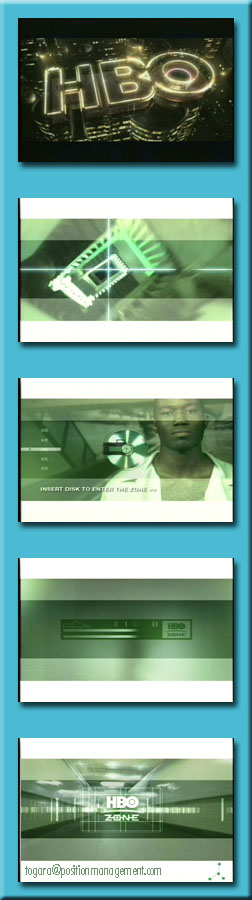 In 2000, long before the phrase 'Sonic Identity or ‘Sonic Branding’ was on everyone’s lips, Blister Media was commissioned to create a unique sound design treatment for a new HBO television channel, HBO ZONE, which was described to us as 'HBO for a GEN X audience'. Our resulting innovative audio packaging not only garnered us substantial acclaim, but the Television Industry community recognized us by awarding Blister with a Gold Promax statue, an award whose significance seemed all the more surreal since our competitors were some of the networks themselves!
While I had already won a couple of CLIOs, and Michael a mention in the New York Times for his work on games, it was this award that finally made me feel like we had arrived.
Both VIDEOGRAPHY and the online mag, digitalproducer.com, asked us to describe our process. What follows is one of the subsequent published articles.
–Terry O'Gara/ August, 2006
Creating a Sonic Identity for a Cable Network: HBO ZONE
By Terry O'Gara
First published by digitalproducer.com, October 1, 2000
Blister was commissioned to create a signature audio identity for the complete inner package introducing HBO viewers to the HBO Zone, an alternative urban movie channel. The package includes opens, closes, transitions, lower-thirds, bumpers, end pages and teases. In the opens, the camera flies through a maze of high-rise buildings to reveal the HBO logo glowing on a rooftop, then drops down below the city streets to a network of tunnels where individuals gain access to the HBO Zone through hand print identification. [Visual treatments were created by New York branch of the design firm, The Attik.] The 'story' behind each interstitial, Intro, Bump, etc. was that the viewer was to experience being transported from HBO to HBO Zone, or from a familiar world to an unfamiliar world.
The Network wanted a sound design treatment that was both emotional and visceral in content, non-musical, more sound design oriented than the typical Network logo. Our process for this project, the assembly of noise into something one might call a composition has it's roots in musique concrete, the process by which ambient sounds are recorded and then manipulated into electronic music pieces. (developed mid twentieth century by Pierre Schaeffer who was in turn influenced by Luigi Russolo's publication 'The Art of Noises'.
Our technique is a natural evolution of the 'art of noises': Our palette of sounds consisted entirely of a variety of noises, ambient sounds, found sounds and the like. And we could have accomplished it with comparable results using 1/4" tape, a reel-to-reel (or several) and a razor blade. But it would have been painstaking to do. So, we did not forgo the convenience of modern technology.
To accomplish our task we first created a palette of sounds from which to create our final electronic music compositions. To do so, we walked the streets of China Town with a Mini Disc Recorder collecting random ambient street sounds. Once we had about an hours worth of material we took it back to Blister and recorded the sounds into Digital Performer. Then we dissected each sound to its constituent parts so that, for instance, a sidewalk store clerk rustling through a barrel of live crabs was edited down to simply a rattle here, a shuffle there, scraping noises and the like. By repeating this process with each set of sounds on from the mini disc, we created a sound palette that sounded not like street ambiance at all, but rather like an endless variety of noise samples, each unique unto itself. Even the wind against the unshielded collar mic proved a useful sound once we sent it through a digital delay plug-in.
We then took the existing HBO fanfare most people associate with the brand and proceeded to 'dirty' it up. To give it a gritty overly compressed sound we recorded the logo from digibeta onto a 3/4" dub, and then again from the 3/4" dub re-recorded it onto a simple audio cassette. Then we sampled it off the audio cassette into the Power Mac G4 where we could use Digital Performer to edit it and add further crackle and pop to it.
Visually, transitions within the interstitial often looked as though they were interrupted by a channel change, or television static, or interference and the like. In today's world of remote controls those changes are often smoothed out by a soft and sometimes inaudible 'click'. So on a short trip to visit my retired parents in Florida I pulled out the old Panasonic black and white TV from my childhood (pre cable, pre remote, pre stereo) and proceeded to record random channel changing of otherwise static UHF channels. The resulting sounds are unarguably hard channel changes, perhaps an almost obsolete sound, certainly clunky, and now seemingly unique, but still immediately recognizable as interrupted transmissions.
We were also fortunate to be the recipients a DAT ostensibly recorded during the Gulf War of a transmission between a fighting crew in a helicopter and their command. It's mostly unintelligible but we garnered sounds from it, including beeps, crackle and feed back. We sampled as much of this as we needed, and again, put it into Digital Performer, and cut it up into components parts.
So, from China Town to the Gulf War and transformed in a digital studio 17 floors above New York City, we had our palette: literally hundreds of sounds which were then assembled via Digital Performer to correspond to, enhance the video, and also to stand alone as being recognizable as HBO Zone logos.
Again, not unlike creating a piece ala musique concrete, we basically created an audio collage out of hundreds of minute sound samples which were dissected and re-assembled using Digital Performer. After the usual presentation and revision process we were 99% done. Once our basic tracks were approved we then further sweetened them with electric guitar. But not with anything melodic. Rather we pulled out an old $35 electric guitar, plugged it in, and destroyed it in the stairwell of our building, running a cable back to the Power Mac G4 to record every step of destruction. The resulting sounds were hardly recognizable as a guitar. Again, splicing those sounds up into their component parts we then processed the lot through a Electrix filter factory to give them an otherworldly feel.
Once the final tracks were approved, we mixed them via the Mackie D8B, and mastered them using a DBX Quantum to make them 'pop' out on broadcast. We delivered the tracks on DAT at 48K.
Making the time and labor intensive project all the more worthwhile, we were honored by the Broadcast Promotions Industry in June 2000 which granted us the Gold Promax award for Original Music/Sound Design for Network packaging.
Wednesday, September 20, 2000
The Golden Age of Online Entertainment Has Just Begun
The Information Age is Over.
And the Golden Age of Online Entertainment has just Begun!
(First Published: Wednesday, September 20, 2000 by clickz)
There are many issues facing media producers who create content for the World Wide Web. These issues affect those of us who enhance the online experience with music, sound design, and audio-specific programming.
Today, ideas demand to be manifest. But tempering the speed of development is the fact that we in audio must wait until our design and programming counterparts implement their contributions before we make ours.
Looming on the horizon is the promise of broadband and convergence. But the horizon is not close enough for those of us who need to make a living today. Especially when traditional forms of production are jeopardized by each technological advance. Digital television recording will wipe out traditional advertising, so they say.
They also say content providers are wary of adding audio because of a perspective that it slows downloads. Where does that leave those of us in the music-production community? Will we be out of our jobs?
If the truth be told, it's a waiting game. Those who can hold their breath longest will survive. And then there will be more work out there than before, and we'll have to learn new techniques and habits again and again before a stable format arrives.
I propose a shift in the way we perceive the online public. We think of them as users, consumers, eyeballs. I say every new person who logs on is less a user and more a member of a growing audience. And audiences demand to be entertained.
Specific to my profession, producing original music and sound design, scoring the web is like scoring a magazine. Audio is a smattering of effects that respond to "clicks." But as the Internet paradigm becomes more like television, audio for the web will become like scoring video or film, albeit a film that one never experiences the same way twice.
It's only a matter of time before television-style web spots replace banner ads as the online ad model. This is good for music and sound houses: A web spot for one product might target a certain demographic - people looking for a car - and the score will be different for subsets. Seniors might hear one track, Boomers another. Gen Xers another still.
How will this get accomplished in a cost-effective manner? Along with a final track, music production houses of the near future will deliver algorithms along with tracks that will convert their original score into another desired style.
And while web spots will be the focus of online advertising, the Internet allows for other formats as well. One growing trend is how content providers are discovering that online games created specific to their sites bring in more eyeballs than, say, simply a banner for a product. The thinking is entertain the audience, and eventually it'll buy something. It already works for television. Game development creates a huge market for designers, programmers, and sound providers.
The same demands for audio on web spots and online games apply to web sites. As broadband opens up and media companies merge with Internet-access companies, Internet users will devolve back into spectators of the unfolding digital pageant.
We are leaving the hunting-and-gathering stage of the Internet. It's no longer about providing dry information but about packaging our brand in a stimulating wrapper to an online spectator. We already pass sites that offer little in their design. Soon sites without sound will seem flat, and even the most utilitarian web destinations will have to consider their entertainment value factor.
Think of the evening news. Theoretically, the news is a simple service: information. But news producers understand that turning service into entertainment and packaging it with exciting graphics and music makes people watch.
Given a choice, audiences don't buy bland. By necessity, audio will play a larger role on the web. But we must move beyond the currently acceptable stock clicks and boinks that continue to be the developer's easiest choice.
Online audio can be very effective. But only if composed with the same care we bring to broadcast. And it must be used judiciously. Use audio to brand your site. Then the eyeballs won't be turning off the sound. Instead, they'll be transfixed. You would be hard put to find an AOL user who isn't delighted to hear "You've Got Mail." A significant portion of AOL's audience lives to hear that announcement. That's branding with audio. And when it works, you're not just a pixel in cyberspace, but a destination site people can't wait to return to.
------------------------------------------------------------
Terry O'Gara is the Executive Producer of Blister Media, a music and sound design firm in New York City. His background includes studies in classical and electronic music composition, and his travels to South America and the Mideast have influenced his general aesthetic. Blister Media provides original material for interactive media, advertising, and broadcast promotions.
Thursday, August 17, 2000
Composing For the World Wide Web
COMPOSING FOR THE WORLDWIDE WED
By Terry O'Gara
First published by Digitrends Daily August 17, 2000
Today, navigating a Web site is like turning pages. When you think of audio on the Web, you think of a site with a smattering of sound effects that respond to a click. A click turns the page and drives the audio, not the other way around.
In the future, audio for the Web will be more like scoring for video or film, as the Internet paradigm becomes more television-like. Web advertising will evolve from banners into a form that approximates television commercials, or 'Web spots'. One exciting prospect for Web audio is that sound will be targeted to the consumer in the same way banner ads are today.
While a Web spot for an automobile might target a certain demographic group, i.e. women, the score accompanying it will be different for sub sets within the overall female demographic. Older women would hear one soundtrack, younger women another, teenagers another still. One spot might have a jazz track, another a classical score, or a rock track, etc.
Musical scores will be specific to demographic groups and to subsets. Don't think this will be uncommon, or that it apply only to text, because there is no such thing as local advertising on the Web.
As can be said of Web spots, so it goes with Web sites. Today content might change depending on who is viewing. In the future, the audio experience will also change. Right now, one is tempted to turn off the audio because it is so often such a banal experience. But as broadband opens up, as media companies merge with Internet access companies, computer users will devolve from being users into spectators of the great unfolding digital pageant. In case you haven't noticed, AOL has taken to using the term 'CHANNELS' to apply to different areas of interest.
True, the Internet will be all things to all people, and will provide an ever-increasing array of services. But I'm talking about that aspect of the Internet that lends itself to entertainment and information gathering. Substantial interactivity may apply to some sites, but the general public will be drawn away from 'destination sites' to Web sites that provide unique, gratifying experience.
We already pass by sites that provide little in the way of design. Before you know it, sites without sound will seem stingy too, if not altogether flat. Audiences don't buy bland, when they have a choice. Think about your own Internet usage. Sites that provide audio cues as you navigate, provide a richer experience than those that don't.
It is only a matter of time before even the most utilitarian destinations on the Web, even B2B sites and search engines, will need to consider entertainment value. Think of CNN, MSNBC, the evening news. Theoretically, the 'News' should survive as a simple information service, but the folks who bring you the news understand that packaging information as entertainment will attract legions who might not otherwise watch.
Branding certainly won't go away as the Internet develops. Just as sound is used to brand in traditional advertising, it will continue to play a role on the Web. One example is AOL's "You've Got Mail" audio cue that has become part of the popular consciousness.
Currently, the Web is a collection of static sites with equally static graphics waiting for you to click on them. That won't continue long. The Web will evolve into a 'moving' experience. Today the Web is like a stack of periodicals. Tomorrow, the Web experience will be like browsing an endless supply of DVDs, as it evolves into a medium where you can watch long-form stories.
I'm not just talking about animated sites, but about interaction, which will become a fluid experience. Amazon.com may still have the capacity to be an online catalog, but it will come to resemble Home Shopping Network or QVC, with a personalized, digitized, interactive sales clerk to help you.
Convergence will demand high-level scoring and sound design. Even content providers who offer text-based information will be forced to the inevitable conclusion that sound and music provide a richer consumer experience. And what about books online? Future online books won't be text downloaded to one's Palm Pilot, but will closely approximate a cinematic experience. As you scroll through the Internet version of a book, a score (not to mention graphics) will accompany it. Instead of just reading that a character is listening to a song on the radio, you'll hear it, too.
Think of the book, "High Fidelity," the story of a man obsessed with music. In the online version, you'll hear the songs the lead character discusses as he mentions them. And then you, the consumer, will click to Amazon.com, or wherever, to buy the music.
Broadband is a means to an end. The audience is driving demand for broadband. When the Internet is delivered through a more sophisticate medium, people will demand a richer experience. It's inevitable that the currently acceptable clicks and boinks won't cut it in a broadband world. And, the opportunities for composers and sound designers will multiply exponentially.
Tuesday, August 15, 2000
BLISTER MEDIA GOES GOTHIC WITH GHOUL SKOOL
BLISTER MEDIA GOES GOTHIC WITH GHOUL SKOOL
PRESS RELEASE
August 15, 2000
It's a familiar story. Confined to society's shadows and backed by an army of dark forces, a demented scientist hatches a plot to dominate the world that has shunned and ridiculed him for so long. Such is the case of Dr. Diabolical, the green-faced, pink-eyed anti-hero of Ghoul Skool, the latest web-based cartoon creation of animation house Pop NYC, with music composed and produced by New York's Blister Media, slated for release on Cartoon Network Online in September, 2000.
Promising to spread evil over the world "like lumpy cheese across a rye cracker," Dr. Diabolical is a dastardly, deliriously-funny creation whose malicious ambition is continually frustrated by his general incompetence. Throughout, the misadventures of Dr. Diabolical and his minions are punctuated by a score heavily influenced by classic horror movies. Originally asked by Creative Director Vincent Lacava for something approaching "ambient cave music," Blister co-founder Michael Sweet's soundtrack is an intoxicating homage to the giddy dementia of the gothic genre.
"I'm a big fan of really bad horror movies," says Sweet gleefully. "Being an addict of the genre, Ghoul Skool was tailor made for me. It was tremendous fun to be able to pull from the wide variety of music styles that were employed in those old movies. It's great when your work and hobbies coincide."
Getting together with his co-founder and Blister Executive Producer Terry O'Gara, Sweet determined to fully explore the creative possibilities. That exploration included, among other things, recording while inside a 17-story stairwell to capture a creepy, echoing reverb effect. As it is with all things, however, work did get in the way of all the challenging fun.
"Whenever you're dealing with distribution over the internet you must constantly consider bandwidth issues," says Sweet somewhat ruefully. "Those, in the end, are usually the toughest issues to overcome. You have to get inside the technology and figure out how to extend the capabilities of the project. You have to hit the right balance between quality sound and manageable file sizes. Speed is always going to be a big factor. Luckily, the guys from Pop NYC are into good sound and are willing to commit the bandwidth to our work. It was a good collaboration."
Ghoul Skool is just the latest collaboration between Blister and Pop NYC. The relationship between the companies goes back to their work on MSN Netwits, an early online game show initiated and hosted by Microsoft. 'Netwits' has since become the equivalent of a television classic for the electronic gaming community. The two companies also worked together on three episodes of 'The Marshmallow Money Show,' which can still be seen on Cartoonnetwork.com. These projects are, however, only the most recent installments in a series of recent projects for Blister Media.
"Blister Media has been on fire this year," O'Gara enthuses. "We've won several awards, which is very satisfying. When Michael and I launched Blister in 1998, despite the considerable experience we both had accumulated over the years, it was like we we went back to being interns again. I became the intern, a rep, the receptionist. We really did everything. This year, it seems to have all come together. I finally feel validated. We're on the map."
Friday, August 11, 2000
Convergence And The Composer
Convergence And The Composer
By Terry O'Gara
Originally published in Shoot Magazine, August 11, 2000
Convergence is the buzz word du jour in media circles. But what does convergence mean for those of us who produce music and sound design? What happens when the public is armed with a digital television that allows viewers to delete commercials with a simple command? You could assume many of us are going to be out of our jobs. But the truth is that there will be more work out there than ever before. Just get ready to learn new techniques and habits again and again before a stable format finally arrives.
So, what's it going to be like? Presently, scoring the Web is like scoring a magazine. And the audio is a smattering of effects that respond to a "click." But as the Internet paradigm becomes more like television, audio for the Web will be more like scoring for video or film. It's only a matter of time before television style Web spots replace banner ads as the online advertising model. This is a good thing for music and sound design production houses: A Web spot for one product might target a certain demographic group, say women; the score accompanying the Web spot will be different for subsets within that demographic. Older women might hear one track, younger women might hear another; teenagers will hear still another. From a production perspective, I'm looking at one spot, three finals! And, heads up, by the way! It's already starting!
The same demands for audio will apply to Websites. As broadband opens up, as media companies merge with Internet access companies, computer users will devolve from being "users" back to being spectators of this great, unfolding digital pageant. Users already pass on sites that provide little in the way of design. Before you know it, sites without sound will seem "flat," and even the most utilitarian of destinations on the Web will have to consider the entertainment value they provide. Given a choice, audiences don't buy bland. The information will draw you in, but the experience gets you to return. By necessity, audio will undoubtedly have to play a larger role than it does now.
Today the Web is like a stack of periodicals. Tomorrow it's going to be more like browsing an endless supply of DVDs. Folks like Atom Films are poised for this. Amazon.com may remain essentially an online catalogue, but it will come to resemble Home Shopping Network or QVC, with a personalized, interactive sales clerk to help you. On the audio post side, this will require clever vocal digitization and thus a new stream of income for those who specialize in creative audio services. Does this mean audio engineers will have to add computer programming to their repertoire? You bet! Welcome to convergence: endless creative possibilities for the consumer, and an increasingly demanding skill set for audio professionals.
Even text-based content providers will be forced to the inevitable conclusion that sound and music provide a richer experience to the consumer. Books online will resemble their cinematic model. As you scroll through the Internet version of the book, a score (not to mention graphics) will accompany it. And then you, the consumer, will be able to go to Amazon.com, or wherever, and buy the music that went with the book.
What's driving this? The audience is, of course. So, it's inevitable that the currently acceptable clicks and boinks won't cut it down the road. But it's exciting that the opportunities for composers, sound designers and audio post will multiply exponentially. That's convergence!
Thursday, July 13, 2000
An Internet Audio Tour de Force from Blister Media
Reprint of Press Release (draft vers.) created by visibilitypr.com and issued in tandem with the launch of the initial phase of the project, regarding Blister Media's role in producing audio for Texaco sponsored Sesame Workshop, 'Passport Kids' Web site. As follows–
AN INTERNET AUDIO TOUR DE FORCE FROM BLISTER MEDIA
PRESS RELEASE
July 13, 2000
Kids Create their Own Songs, Jam to Others'
at the New Sesame Workshop 'Passport Kids' Web site
INTRO:
Audio on the Internet is in its infancy. Two year old New York City interactive music house Blister Media has consistently pushed the interactive audio envelope, recognizing that the Web will not reach its full potential until it delivers a rich audio-visual experience.
BRIEF:
Sesame Workshop's online service, Passport Kids, lacked a dedicated musical interface. In planning to redesign the site, SW's Robert Michaels asked Blister Media how they might incorporate an interactive educational musical experience. Blister Media presented three concepts; the winning concept allows kids to create a personal song by combining musical elements from around the world (an audio identity that parallels the visual avatar kids create on their personal SW Web page). Other kids can visit the page, listen to the song, and jam along by adding other instruments.
ABOUT SESAME WORKSHOP:
From creating your own song, the project evolved to enable others to interact, play along, and jam, with your song. Blister created five rhythms, offering as much geo/cultural diversity as possible - African, East Indian, pan Asian (Japanese), Latin, and Modern; and offers a choice of 10 melodic instruments: mandolin, acoustic bass, didgeridoo, gamelan, accordion, steel drum, trumpet, zurna, sitar and panpipe.
Blister creative director Michael Sweet composed pieces from which individual songs can be built.
THREE SECTIONS:
1. Make My Song... create a musical avatar.
2. Jam with my Song... allows another to play along.
3. Global Groove (now open to the public)... allows users to hear instruments
(demo mode).
ACCESSING PASSPORT KIDS:
• Click on the passport icon to go to your page.
• Click on make my tune.
• Roll mouse over instrument icon to play a note.
• Click to play the instrument.
• Double click on the instrument link and a pop-up screen offers more
information.
• Choose a rhythm, drag the instruments, select from four melody blocks.
• Can combine two instruments, plus rhythm.
TECH NOTES:
Sound files are generated on the fly using Beatnik and custom instrument samples collected by Blister Media from around the world. Blister Media wrote code for an engine built upon Beatnik, allowing users to integrate sound files and instrument
into rhythm patterns, a new use of the Beatnik technology. Songs are built around a looping measure of four sections to each rhythm. One composes with 'blocks' of sound, rearranging them as desired to create nearly endless musical possibilities.
Explains Michael Sweet, Creative Director, Blister Media:
"Sesame Workshop is our most ambitious Internet audio project to date and takes the state of interactive online audio into new territory. It comes down to having thought of the idea first. But it's not just about the technology, but what it can do. If you forget about the technology you might end up trying to put your music into a box that it won't fit into. We try to push the limits of the box. Or get into the box and push the walls outward. This is what we've done with Beatnik in building the Sesame Workshop audio site."
Requirements:
Beatnik and Flash
Pentium II or better, Power Mac
Audio and Audio Coding Credits:
Blister Media: Terry O'Gara, executive producer
Michael Sweet, creative director
Site Development:
Modstar, NYC
Launched July 13, 2000 phase one. Full site now open exclusively to Intel users.
Full site opens to public (date TBD).
Monday, May 01, 2000
Branded Mixes
A Brand Mix is a playlist (or a selection of playlists) created by one or more music supervisors or DJ/brand strategists commissioned a corporate patron or advertiser.
For instance: Buy a BMW and download fifty songs that you can listen to later –not just any fifty songs, mind you. I'm suggesting you select material that brings to mind that BMW is indeed The Ultimate Driving Machine.
Now rinse and repeat: Good for every product and service available worldwide.
The music on the playlist can be arrived at by any number of ways: It simply might be comprised of a variety of licensed tracks from several artists; or it might feature the works of one artist –your strategic audio partner, so to speak. Or the music might all be original compositions commissioned expressly for a specific Branded Mix project; or some combination of the above.
Ideally, song selections meet the criteria put forth in formal brand analysis.
In effect, a consumer goods brand provides a soundtrack to their consumer's lives. –Whether consumers listen to the mixes driving or washing laundry, the music serves the purpose of sustaining an 'off line' connection between brand and consumer.
As a consequence, a thriving singles market can be expected to flourish. However, also expect the music industry's primary market to change from primarily being Business-to-Consumer, to Business-to-Business.
In case you're getting the wrong idea, I don’t want to see my favorite artists dressed up like NASCAR drivers. Rather, following a Medici Model I am suggesting implementing a process that resembles the way art collector/marketer Charles Saatchi nurtured the school of Young British Artists (Damien Hirsch, Cornelia Parker, Tracy Emin, Sarah Lucas, Chris Ofili, et al) by seeding interest in each artist with not just funding, but with his very association. It worked the other way around, too. Saatchi's currency as a collector increased by virtue of his association with them.
The Young British Art scene delivered us a wonderful cultural loop whereby the collector could demonstrate good taste through his discoveries; and having been chosen by a person with presumably good taste, the artists could claim a measure of brilliance for themselves –even if the art in question was made with poop or comprised of dead sharks in tanks of formaldehyde. The parallels with much modern pop music are indeed astounding.
Packaging music with a sponsor's products or services can make real sense when both band and brand aspire to appeal to the same or overlapping demographics. Brand Mixes work especially well in environments (hotels, retail, etc) if the success of MUZAK can be any indication. The Muzak company may be synonymous with bland music, but that has changed. In any case, taste is not the issue of this entry, PROCESS is. –And the process I'm describing combines a DJ's ears with a brand audit.
Regardless, one hopes any tie-in might also alert potential fans of any given artist's material (by virtue of its selection into the Mix), like an audio beacon – and not unlike radio, come to think of it.
I’m only being partly facetious when I say that were one to distribute The Cure’s Greatest Hits as a redeemable coupon for downloadable music files with every box of Count Chocula, that cereal would become the first breakfast of choice for Goth fans and gender confused teens worldwide.
For other articles in this series:
ROCK BRANDS: Tomorrow's Rock Star Marketing Partners
Branded Mixes
Medici Model Revisited
Artist X Brand X Not Available @ iTunes
Strategic Audio Partnerships
Diplomatic Corps Rock Fest
Saturday, April 01, 2000
ROCK BRANDS: Tomorrow's Rock Star Marketing Partners
Consider Rock Star Sting’s association with Jaguar:
In March/2000, Jaguar launched a commercial for the new Jaguar S-Type. Sting is not just featured in the spot; he and his manager pitched the very concept of the campaign to the automobile maker.
In an age when MTV doesn't play music videos, and even if it did, doesn’t play Sting’s, and certainly wouldn't play yours, having a sponsor subsidize your video in return for product placement, –AND organize and pay for a huge media buy on top of it– is a bit different than helping sell cars.
For Jaguar, the opportunity to work with Sting yielded a branding opportunity that was not just entertaining, but in fact proves wildly popular. The association with a vehicle like the Jag no doubt worked to Sting's benefit as well. In fact, what possibly made this campaign unique among TV commercials is the fact that neither artist nor his music were featured only as a means to enhance the sales pitch for the automobile. Rather both car and artist/music were partnered in a clever way to sell each other (!).
You or someone else may dislike the pairing, but both the artist's music and the vehicle emerge as simultaneously contemporary and timeless masterpieces.
This is an important point: The Jaguar ads resemble typical advertising only insofar as one can define advertising as anything that gets attention –which they certainly did –exceeding the expectations of both the artist and his corporate underwriter.
Far from being just another endorsement or sponsorship deal, when we look at this campaign it's easy to envision it as presenting us with a new model for an entirely different kind of music-cum-marketing industry. I describe this new kind of partnership between corporate underwriters and their Strategic Audio Partners as ROCK BRANDS.
In this new paradigm, recording artists (in tandem with their management teams) won't so much do business with advertising companies. Instead they'll present a non-public version of themselves to advertisers as marketing consultants, accommodating representation for a select group of brands that both reflects and enhances the lifestyle and core values of the artist or band.
Artists of various kinds and possessing different skill sets in this arena will deliver varying degrees of input and expertise. Some will be completely hands on. Others will staff their branding/marketing concerns with a professional creative staff that operate integrate the artist's message in their mission statement.
Particularly astute artists won't just show up and do a commercial or put in face-time at an event, but will be active participants in the concepting and production of original marketing strategies for their client/patrons.
In addition to a manager, a lawyer, an agent and publicist, an artist's team will now include a uniquely qualified marketing lead (or brand representative). This person will act as both a brand manager for the artist (or may in fact be the manager of the artist), and as a creative strategist for the artist (for marketing partnerships and projects, not the artist's content, of course).
One can also imagine a need for new kind of consultant –if such people do not already exist (and I think they must)– whose sole purpose is helping artists draft corporate mission statements in order to present these boutique entities not to advertisers, but perhaps to investors and other speculative parties.
For other articles in this series:
ROCK BRANDS: Tomorrow's Rock Star Marketing Partners
Branded Mixes
Medici Model Revisited
Artist X Brand X Not Available @ iTunes
Strategic Audio Partnerships
Diplomatic Corps Rock Fest
Thursday, March 30, 2000
Producer's Syllabus Series
What does a commercial music producer do? –you ask. Believe it or not, more than simply choosing guitar/amp configurations. Read all about it via these key articles from the Producer's Syllabus Series*:
Producer's Syllabus
*I'll be updating the entries from time to time, adding links to external sources as I come across them.
Producer's Syllabus
*I'll be updating the entries from time to time, adding links to external sources as I come across them.
Subscribe to:
Posts (Atom)